Introduction: The Critical Importance of Payment-EPOS Integration
For retail businesses, the seamless connection between payment processing and Electronic Point of Sale (EPOS) systems has evolved from a convenience to a business necessity. A comprehensive retail merchant services comparison reveals that integration quality can significantly impact operational efficiency, customer experience, and even revenue. According to Retail Excellence Ireland, merchants with fully integrated payment and EPOS systems experience 12-18% higher operational efficiency and 7-9% fewer transaction errors compared to those using disconnected solutions. Beyond efficiency, proper integration enables enhanced inventory management, customer loyalty programs, and detailed sales analytics that drive business growth. At Compayre.ie, we’ve evaluated the integration capabilities of major payment processors to help retailers identify solutions that offer the optimal combination of compatibility, features, and value for their specific EPOS environment.
Understanding EPOS Integration Requirements
Core Integration Functionality Essentials
Before conducting a software integration comparison, retailers should understand the fundamental connection types:
Basic Integration Requirements
- Transaction synchronization: Payment details flowing to EPOS
- Automated reconciliation: Matching sales to payments
- End-of-day balancing: Simplified closing procedures
- Refund/void handling: Consistent cancellation processing
- Receipt generation: Unified documentation
Advanced Integration Capabilities
- Real-time inventory updates: Stock adjustments upon payment
- Multi-location synchronization: Cross-store consistency
- Customer data capture: Profile creation and enhancement
- Loyalty program triggers: Point accrual and redemption
- Gift card management: Issuance and transaction processing
The Small Firms Association reports that approximately 35% of small retailers use partially or completely disconnected payment and EPOS systems, creating significant operational inefficiencies and data inconsistencies.
Integration Architecture Options
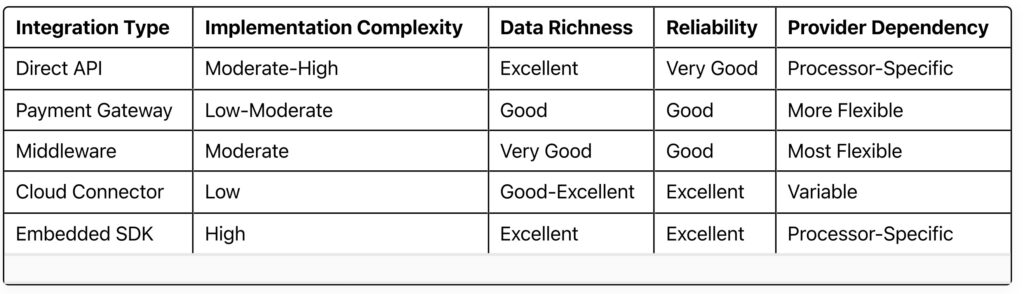
Several technical approaches enable payment-EPOS connectivity:
Integration Method Comparison
Key Selection Factors
- Real-time vs. batch synchronization: Timing of data transfer
- On-premise vs. cloud connectivity: Infrastructure requirements
- Data flow directionality: One-way or bi-directional communication
- Authentication mechanisms: Security implementation options
- Failover capabilities: Behavior during connectivity issues
Our integration architecture guide provides detailed explanations of these connection methods to help you understand potential integration approaches.
Popular EPOS Systems and Their Payment Compatibility
Leading Retail EPOS Platforms
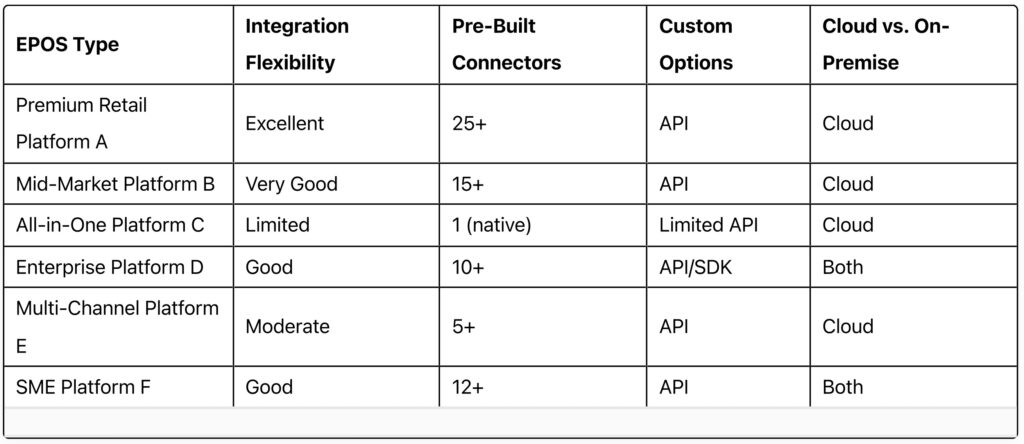
The Irish retail market features several dominant EPOS solutions:
Major EPOS Platform Integration Capabilities
Integration Support Quality Factors
- Documentation comprehensiveness: Developer resource quality
- Implementation support: Technical assistance availability
- Testing environment access: Development sandbox options
- Version compatibility: Update coordination practices
- Certification requirements: Processor validation processes
The software integration comparison process should begin with identifying your current or planned EPOS system and its specific integration capabilities.
EPOS-Specific Integration Challenges
Different EPOS platforms present unique integration considerations:
System-Specific Integration Factors
- Premium Retail Platform A: API key management and version compatibility
- Mid-Market Platform B: Synchronization timing and inventory reconciliation
- All-in-One Platform C: Limited third-party payment options
- Enterprise Platform D: Complex SDK implementation requirements
- Multi-Channel Platform E: Gateway restrictions and checkout flow
- SME Platform F: Plugin stability and version management
Our EPOS compatibility checker can help identify the optimal payment processors for your specific retail system. For specialized EPOS options, NPI.ie and SmartPOS.ie offer additional compatibility insights for the Irish market.
Payment Processors with Superior EPOS Integration
Direct Integration Leaders
These processors offer the most comprehensive native EPOS connections:
Processors with Extensive Direct Integrations
- Enterprise Payment Solution A: Connects directly with 30+ EPOS systems
- Native integration with Premium and Mid-Market platforms
- Real-time bi-directional data synchronization
- Transaction-level data enrichment
- Simplified implementation process
- Strong developer documentation
- Established Payment Provider B: Compatible with 25+ retail platforms
- Embedded SDK for Multi-Channel and SME platforms
- Pre-built plugins for major EPOS systems
- Cloud-based integration architecture
- Offline transaction synchronization
- Comprehensive implementation support
- Retail-Focused Processor C: Specialized in retail integrations
- Retail-focused API structure
- Advanced inventory synchronization
- Multi-location capabilities
- Detailed transaction metadata
- Retail-specific developer tools
According to our retail merchant services comparison research, processors with native integrations typically provide 30-40% faster implementation timeframes and significantly higher data reliability compared to third-party connections.
Gateway-Based Integration Options
Payment gateways often provide broader compatibility through standardized connections:
Leading Gateway Integration Providers
- Major Gateway Solution X: Connects with 40+ EPOS systems
- Standardized API structure
- Universal plugin availability
- Consistent implementation approach
- Gateway-level reporting tools
- Simplified certification process
- Retail-Specialized Gateway Y: Retail-optimized connections
- Retail-specific data fields
- Inventory-aware processing
- Customer profile enrichment
- Multi-channel capabilities
- Unified reporting dashboard
- Cloud Gateway Platform Z: Cloud-based integration platform
- No on-premise components
- Continuous compatibility updates
- Automated synchronization
- Minimal technical requirements
- Self-service implementation tools
The European Retail Technology Association notes that gateway-based integrations often provide greater flexibility for retailers using multiple or specialized EPOS systems, particularly those available through Irish providers like SmartPOS.ie.
Middleware-Facilitated Connections
For complex retail environments, middleware solutions enable customized integration:
Retail Integration Middleware Providers
- Enterprise Middleware Solution 1: Retail-specialized connectors
- Custom field mapping capabilities
- Complex workflow orchestration
- Legacy system compatibility
- Advanced transformation tools
- Multi-directional data flow
- Integration Platform 2: Enterprise retail platform
- Multi-system synchronization
- Centralized integration management
- Comprehensive monitoring tools
- Version upgrade isolation
- Cross-platform consistency
According to our software integration comparison analysis, middleware solutions typically add 15-25% to implementation costs but can reduce long-term integration maintenance expenses by 30-50% for complex retail environments. NPI.ie offers specialized integration services for retailers requiring custom middleware solutions in the Irish market.
Inventory Management Integration Capabilities
Real-Time Inventory Synchronization
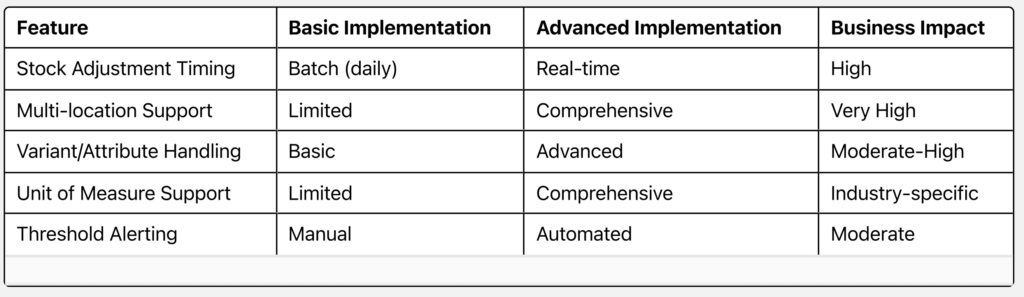
Inventory accuracy represents a critical integration benefit:
Inventory Integration Feature Comparison
Impact on Retail Operations
- Reduced overselling: Prevents inventory availability errors
- Accurate online availability: Consistent cross-channel stock
- Optimized ordering triggers: Data-driven replenishment
- Shrinkage identification: Discrepancy pattern recognition
- Staff efficiency improvements: Reduced manual reconciliation
A thorough retail merchant services comparison should evaluate how payment-EPOS integration impacts inventory accuracy and management efficiency.
Advanced Inventory Capabilities
Beyond basic stock levels, sophisticated integrations offer enhanced functionality:
Specialized Inventory Features
- Supplier order integration: Connecting purchasing to sales
- Serial/lot tracking: Item-specific identification
- Bundle/kit processing: Component inventory management
- Consignment handling: Special ownership tracking
- Seasonal inventory flags: Time-based stock indicators
The most advanced integrations in our software integration comparison enable 30-45% reductions in inventory management labor while improving stock accuracy by 15-25%.
Customer Loyalty and Profile Management
Unified Customer Experience Enablement
Integration directly impacts loyalty program effectiveness:
Customer Profile Integration Elements
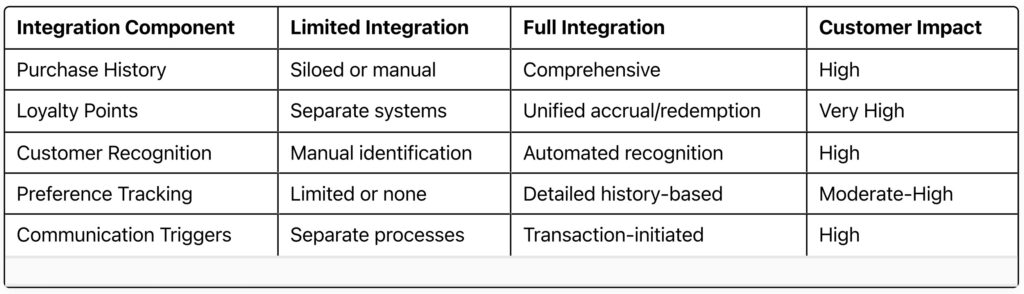
Loyalty Program Enhancement
- Automated point accrual: Transaction-based rewards
- Seamless redemption: Cross-channel point usage
- Targeted promotions: Purchase history-driven offers
- Recognition automation: Consistent VIP identification
- Program performance analytics: Detailed engagement metrics
According to Retail Ireland, fully integrated loyalty programs achieve 35-60% higher member engagement rates compared to disconnected systems.
Visit our loyalty integration assessment tool to evaluate how different integration approaches impact customer engagement capabilities.
Customer Data Enrichment Methods
Integration enables enhanced customer understanding:
Profile Data Enhancement Capabilities
- Purchase pattern analysis: Buying frequency and preferences
- Cross-category visibility: Complete spending profile
- Return/exchange history: Product satisfaction indicators
- Payment method preferences: Favored transaction types
- Channel utilization patterns: In-store vs. online behavior
The most effective integrations in our retail merchant services comparison create single customer views that unify all transaction and interaction data, enabling 25-40% more effective personalization and targeting.
Analytics and Reporting Capabilities
Unified Business Intelligence
Integrated systems provide enhanced analytical capabilities:
Reporting Integration Benefits
- Single data source: Consistent numbers across systems
- Multi-dimensional analysis: Sales by payment type, category, etc.
- Cross-referential reporting: Payment data connected to products
- Trend identification: Pattern recognition across datasets
- Anomaly detection: Unusual transaction identification
According to software integration comparison research by Enterprise Ireland, integrated analytics typically reduce reporting time by 60-80% while improving data accuracy by 15-30%.
Payment-Enhanced Analytics
Transaction data significantly enriches business intelligence:
Enhanced Analysis Capabilities
- Payment method influence: Impact on basket size/composition
- Financing option analysis: Effect of payment choices on sales
- Discount effectiveness: Promotion impact by payment type
- Chargeback pattern identification: Fraud/customer satisfaction indicators
- Fee optimization opportunities: Processing cost reduction insights
The most advanced integrated analytics identified in our retail merchant services comparison enable retailers to optimize payment acceptance strategies for an average 0.3-0.7% reduction in processing costs.
Implementation Considerations and Challenges
Integration Project Planning Guidance
Successful implementations require careful planning:
Key Implementation Phases
- Requirements definition: Detailed functionality documentation
- Integration method selection: Connection approach determination
- Provider evaluation: Compatibility and capability assessment
- Development and configuration: Connection establishment
- Testing and validation: Functionality verification
- Training and rollout: Staff preparation and deployment
- Monitoring and optimization: Ongoing performance evaluation
Common Implementation Challenges
- Version compatibility issues: EPOS update coordination
- Data mapping complexities: Field match and transformation
- Authentication configuration: Security implementation difficulties
- User acceptance barriers: Staff resistance to new workflows
- Performance optimization: Speed and reliability tuning
Our implementation roadmap template provides a structured approach to integration planning.
Integration Cost Considerations
Several factors influence the total integration investment:
Cost Component Analysis
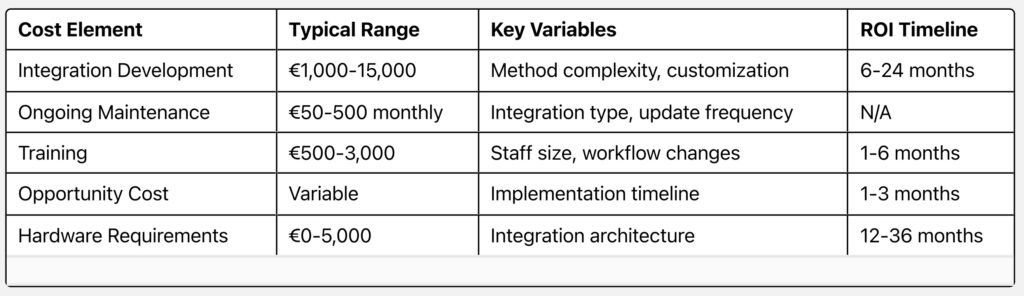
A thorough software integration comparison should include total cost of ownership analysis across short and long-term horizons.
Case Studies: Successful Integration Implementations
Small Retail Business Integration
A boutique clothing retailer successfully integrated payment processing with their EPOS:
Challenge: Disconnected payment and inventory systems causing reconciliation issues and staff inefficiency
Solution: Implemented cloud-based integration between existing EPOS and new payment processor
Key Benefits Achieved:
- 45 minutes saved daily on reconciliation and closing procedures
- 3.5% improvement in inventory accuracy
- 28% increase in loyalty program enrollment
- Detailed analytics enabled data-driven purchasing decisions
- Staff able to complete transactions 20% faster
ROI Timeline: Integration costs recovered within 5 months through efficiency gains and improved inventory management.
Multi-Location Retail Chain Implementation
A sporting goods retailer with 8 locations enhanced their operation through advanced integration:
Challenge: Inconsistent payment processes across locations creating reporting challenges and customer experience variations
Solution: Enterprise-grade middleware connecting unified payment processing with centralized EPOS
Key Benefits Achieved:
- Standardized checkout experience across all locations
- Real-time inventory visibility reducing out-of-stock issues by 32%
- Centralized customer profiles enabling chain-wide loyalty recognition
- Cross-location analytics identifying performance optimization opportunities
- Streamlined financial reconciliation reducing accounting costs by 20%
ROI Timeline: 9-month payback period with significant ongoing benefits in customer satisfaction and operational efficiency.
Selecting the Optimal Integration Approach for Your Business
Decision Framework for Retail Businesses
Follow this structured approach to integration selection:
Step 1: Requirements Assessment
- Document current pain points: Specific operational challenges
- Identify integration priorities: Must-have vs. nice-to-have features
- Establish technical parameters: EPOS system and version details
- Define budget constraints: Available investment and ROI requirements
- Outline timeline needs: Implementation urgency and business cycle
Step 2: Provider Evaluation
- Create integration shortlist: Compatible processor identification
- Request detailed capabilities: Specific feature availability
- Verify reference implementations: Similar retailer experiences
- Assess support quality: Implementation and ongoing assistance
- Compare total ownership costs: Complete investment analysis
Our integration provider assessment worksheet provides a structured evaluation framework for comparing options.
Conclusion: Maximizing Value Through Strategic Integration
The connection between payment processing and EPOS systems represents one of the most consequential technology decisions for retail businesses. Our comprehensive retail merchant services comparison demonstrates that integration quality directly impacts operational efficiency, customer experience, and business intelligence capabilities.
Rather than treating payment processing as separate from your EPOS environment, we recommend conducting a thorough software integration comparison that evaluates how different processors align with your specific retail platform and business requirements. The optimal solution often isn’t the processor with the lowest transaction fees but rather the one offering the best combination of integration quality, features, and value for your retail operation.
At Compayre.ie, we help Irish retailers navigate these complex integration decisions with vendor-neutral comparisons and personalized recommendations based on your specific EPOS environment and business priorities.
Frequently Asked Questions
How much does payment-EPOS integration typically cost for small retailers?
Integration costs vary significantly based on implementation approach and EPOS platform. Cloud-based integrations using pre-built connectors typically range from €500-2,500 in initial setup costs with minimal ongoing expenses. Custom integrations using direct APIs or middleware generally range from €2,500-10,000 with monthly maintenance costs of €100-400. For most small retailers with standard EPOS systems, selecting a processor with pre-built integration can minimize both cost and complexity while delivering 80-90% of potential benefits.
Do I need to change my EPOS system to achieve better payment integration?
Not necessarily. Most established EPOS platforms offer integration options with multiple payment processors. The key is identifying which processors provide the best pre-built or easily implemented connections for your specific system and version. According to our retail merchant services comparison research, approximately 85% of retailers can achieve significant integration improvements without changing their core EPOS platform by selecting compatible payment processors and appropriate connection methods.
How long does a typical payment-EPOS integration implementation take?
Implementation timelines vary based on integration complexity and EPOS system. Pre-built integrations with cloud-based EPOS platforms typically require 1-3 weeks from decision to full deployment. Custom integrations using APIs or middleware generally require 4-12 weeks depending on customization requirements and technical complexity. The most significant variables affecting timeline are customization needs, data migration requirements, and staff training considerations. Well-planned implementations with clear requirements typically achieve the shortest timelines.
Can integrated payment-EPOS systems work during internet outages?
Yes, though capabilities vary by integration architecture. The most resilient integrations implement “offline modes” that cache transaction data locally during connectivity disruptions, automatically synchronizing once connection is restored. On-premise integrations typically offer stronger offline capabilities compared to fully cloud-based solutions. When evaluating integration options, retailers with connectivity concerns should specifically assess offline functionality, including transaction approval capabilities, data caching methods, and synchronization processes for reconnection periods.
How do payment-EPOS integrations impact data security and PCI compliance?
Well-designed integrations can actually enhance security by reducing manual data handling and implementing end-to-end encryption. The most secure architectures use tokenization to eliminate card data storage within the EPOS system while maintaining full transaction records. This approach can significantly reduce PCI scope and compliance costs. However, poorly implemented integrations may create security vulnerabilities through expanded attack surfaces or inappropriate data storage. Always verify that integration methods maintain appropriate data separation, implement strong encryption, and follow current PCI DSS requirements.
Need personalized guidance selecting the optimal payment-EPOS integration for your retail business? Contact Compayre.ie at +353 1 265 4403 for expert advice tailored to your specific EPOS environment. As a Guaranteed Irish company, we understand the unique challenges Irish retailers face and can help you identify integration approaches that maximize efficiency while minimizing complexity and cost.
*[EPOS]: Electronic Point of Sale *[API]: Application Programming Interface *[SDK]: Software Development Kit *[PCI DSS]: Payment Card Industry Data Security Standard *[ROI]: Return on Investment